



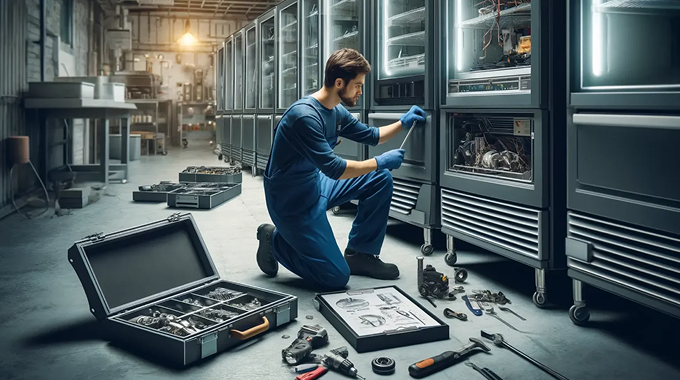
Thermodynamics ensures reliable year-round preventive and corrective maintenance for commercial refrigeration systems, designed to maximize efficiency and minimize downtime. Our service plan includes quarterly inspections, precise system calibration, refrigerant monitoring, coil and drain cleaning, and OEM-quality parts replacement when required. All labor, scheduled service visits, and emergency repairs are fully covered with transparent, no hidden costs. Clients benefit from a guaranteed 24/7 emergency response within four hours, along with direct access to a dedicated technician support line. After each visit, detailed digital reports highlight completed work, condition assessments, and expert recommendations. For client convenience, contracts renew automatically on an annual basis unless terminated with a 30-day written notice, ensuring uninterrupted service and consistent system reliability.

Quarterly inspections record temperature, pressure, and electrical load data to detect early signs of system issues, with anomalies flagged for immediate action.
Filters, coils, drains, and pans are thoroughly cleaned, while motors and hinges are lubricated to enhance efficiency and extend equipment lifespan.
Refrigerant levels are tested and adjusted to OEM specifications, with certified leak detection performed; all leaks sealed and documented for compliance.
Critical components such as gaskets, thermostats, valves, and sensors are replaced using OEM or approved parts to ensure long-term system reliability.
A 24/7 technician hotline guarantees emergency response with on-site arrival within 4 hours—without hidden fees or additional labor charges.
Every service concludes with a digital report detailing system readings, maintenance tasks, parts replaced, and expert recommendations—accessible anytime online.

Annual Maintenance Contract (AMC) for Refrigeration ensures reliable performance, energy efficiency, and reduced downtime. Regular inspections, timely repairs, and preventive care extend system life, helping businesses safeguard perishable goods while cutting costs and maintaining uninterrupted operations.

Boosting cooling efficiency, product display quality, and energy savings in commercial refrigeration environments.

Safeguarding temperature-sensitive cargo through advanced retrofit and maintenance strategies for large-scale cold storage facilities.

Delivering energy-efficient upgrades and retrofits to support smooth, safe kitchen operations and improved guest comfort.

Ensuring stable temperatures and hygienic conditions with dependable system upgrades and replacements for commercial refrigeration.

Tailored retrofit solutions reduce operational costs, enhance airflow, and maintain equipment safety under demanding, heavy-duty usage.


A commercial refrigeration retrofit involves upgrading selected components of an existing system to improve efficiency, reliability, temperature control or operating life. Depending on the system, this may include compressors, condensers, controls, cabinets, doors, motors, fans or other refrigeration components. The objective is to modernise the existing installation without necessarily replacing the complete system.
Repair is generally appropriate for an isolated fault on otherwise reliable equipment. A retrofit can be more suitable when the existing system remains structurally sound but has inefficient or outdated components. Full replacement becomes preferable when major components are obsolete, repeated failures occur, the system is severely degraded or retrofit costs approach the value of a new installation.
A retrofit can reduce energy consumption by replacing inefficient components, improving heat rejection, reducing cooling losses and optimising system operation. Depending on the installation, upgrades may include compressors, condensers, motors, controls, insulated doors or other components. Actual savings depend on the existing system, operating conditions, load profile and quality of the retrofit design.
Common indicators include rising electricity consumption, unstable temperatures, frequent breakdowns, declining cooling performance, excessive compressor operation, refrigerant problems and increasing maintenance costs. Age alone does not necessarily mean a system needs upgrading. A technical assessment should identify whether the problem can be resolved through maintenance, component replacement or a wider retrofit.
Depending on system design and compatibility, components such as compressors, condensers, evaporators, fans, motors, controls, refrigeration cabinets, doors and other system elements can potentially be upgraded individually. The complete refrigeration circuit should be assessed before modification to ensure that the new components are correctly matched to the existing cooling capacity and operating conditions.
Yes. Upgrading inefficient refrigeration components, controls, insulation or display systems can improve temperature regulation and reduce fluctuations. Stable temperatures are particularly important for food, pharmaceutical and other temperature-sensitive products. However, the final performance depends on equipment selection, refrigeration capacity, loading patterns, door openings, ambient conditions and maintenance.
High ambient temperatures increase the heat-rejection demand placed on refrigeration systems. This can raise condensing temperatures, compressor workload and electricity consumption, particularly when condensers are undersized, dirty or poorly ventilated. Systems operating in Saudi Arabia should therefore be selected and maintained according to local design conditions, adequate heat-rejection capacity and the required cooling load.
Retrofit costs vary according to system capacity, components being replaced, equipment condition, refrigerant, installation complexity, site access and commissioning requirements. A minor component upgrade and a large industrial refrigeration modernisation project can have very different costs. A technical survey is necessary to identify the required work and prepare an accurate quotation.
Project duration depends on system size, the number of components being upgraded, equipment accessibility, refrigerant recovery, electrical or piping modifications and commissioning requirements. Smaller retrofits may require limited downtime, whereas large commercial or industrial installations may need phased implementation and planned shutdowns to maintain business continuity.
ROI should consider the initial retrofit investment against expected energy savings, reduced maintenance, lower breakdown costs and extended equipment life. Operating hours, refrigeration load, electricity tariff and existing system efficiency should be included in the calculation. Comparing the retrofit's lifecycle cost with full system replacement provides a more meaningful investment decision.
Next-Gen Cooling. Made for Saudi
Environments.
We provide advanced commercial cooling solutions that reduce emissions and drive energy-efficient, sustainable performance.
Tell us more about yourself and what
you have got in mind.
Our Solutions
Certificates

ISO 9001

ISO 14001

ISO 45001

ICV

 UAE
UAE
 Oman
Oman
 Qatar
Qatar
 KSA
KSA
 Kuwait
 India
India
Social Media


Certificates
ISO 9001
ISO 14001
ISO 45001
ICV
UAE
KSA
Oman
Kuwait
Qatar
India


