Executive Summary
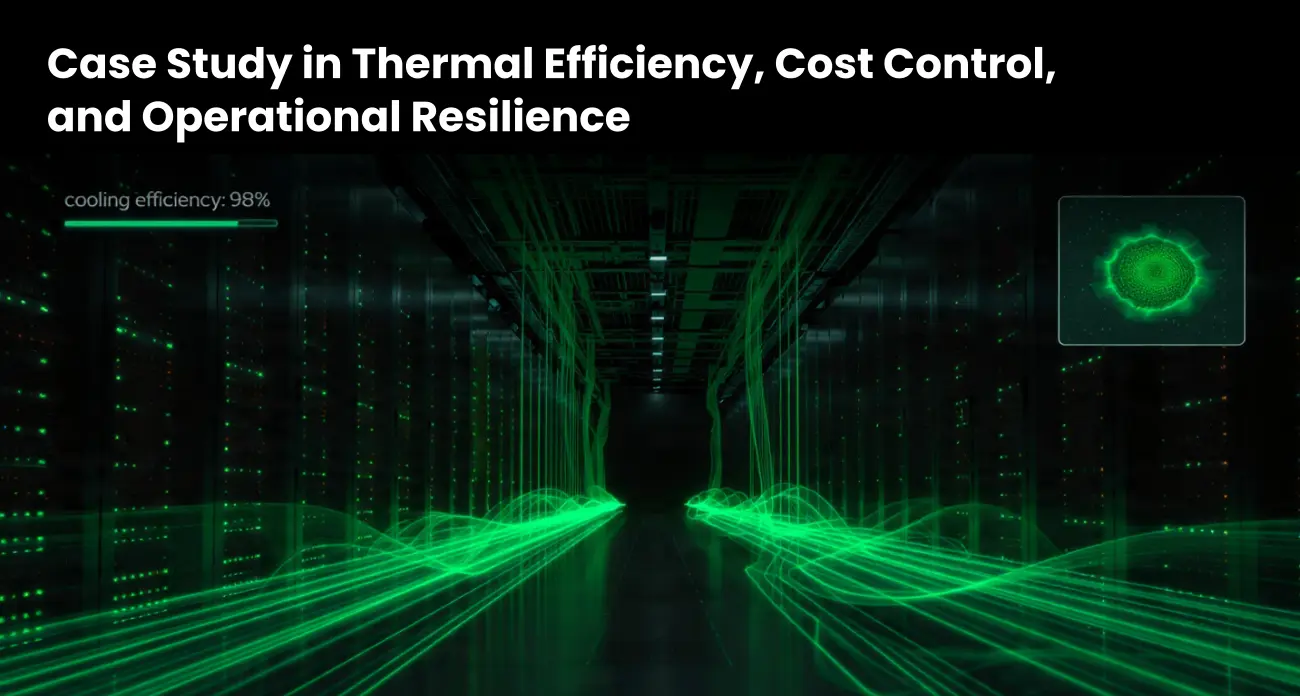
Modern enterprises are under constant pressure to scale digital services while controlling energy costs and meeting sustainability targets. At the center of this challenge lies data center cooling—a discipline that directly affects uptime, operating expenditure, and long-term infrastructure resilience.
This case study examines how a mid-sized enterprise data center transformed its thermal performance by rethinking data center thermal management, adopting precision cooling, and executing a phased cooling optimization strategy. The result was a measurable reduction in energy consumption, improved Power Usage Effectiveness (PUE), and a cooling architecture ready for future growth.
Client Background
The client operates an enterprise-grade data center supporting mission-critical applications for finance, analytics, and customer platforms.
- Facility type: Enterprise data center
- IT load: ~2.5 MW
- Rack density: Mixed (5–12 kW per rack)
- Cooling model (before): Traditional perimeter CRAC units
- Growth outlook: 30–40% capacity increase over three years
As compute demand grew, the existing cooling setup struggled to keep pace, triggering rising energy bills and thermal instability.
Problem Statement
Despite sufficient installed cooling capacity, the data center faced persistent inefficiencies:
- High PUE (2.1) driven by excessive cooling energy use
- Localized hotspots near high-density racks
- Overcooling in low-load zones
- Increasing operational costs and sustainability concerns
The root issue was not lack of cooling equipment, but ineffective airflow management and outdated assumptions about load distribution. The organization needed a modern data center cooling solution aligned with real-world usage patterns.
Cooling Strategy & Technology Selection
A detailed thermal assessment was conducted using airflow modeling, rack-level temperature sensors, and energy monitoring tools. Based on the findings, a hybrid cooling strategy was selected.
Key Technology Choices
1. Precision Cooling Deployment
In-row precision cooling units were introduced near high-density racks, enabling targeted heat removal and reducing reliance on perimeter cooling.
2. Hot Aisle / Cold Aisle Containment
Physical containment minimized air mixing, ensuring cold air reached IT equipment intakes while hot exhaust air was efficiently returned to cooling units.
3. Variable-Speed Fans & Controls
Dynamic fan control adjusted cooling output in real time, matching actual IT load rather than theoretical peak demand.
4. Energy-Efficient Data Center Cooling Design
The solution emphasized modularity and scalability, avoiding overprovisioning while preparing for future expansion.
Implementation Process
The project was executed in three structured phases to avoid operational disruption.
Phase 1: Design & Validation
- Computational Fluid Dynamics (CFD) modeling
- Rack-level thermal mapping
- Baseline energy and PUE benchmarking
Phase 2: Deployment
- Installation of containment systems
- Integration of precision cooling units
- Gradual decommissioning of redundant CRAC capacity
Phase 3: Cooling Optimization
- Fine-tuning airflow paths
- Calibrating temperature setpoints
- Continuous monitoring via DCIM tools
This phased approach ensured uptime while enabling data-driven decision-making throughout the transition.
Results & Metrics
The impact of the optimized data center cooling strategy was both immediate and measurable.
| Metric | Before | After |
|---|---|---|
| Power Usage Effectiveness (PUE) | 2.1 | 1.55 |
| Cooling energy consumption | Baseline | ↓ 28% |
| Hotspot incidents | Frequent | Eliminated |
| Annual energy cost | High | ↓ ~22% |
| IT uptime | Stable | Improved resilience |
Beyond numbers, operational teams reported greater confidence in handling peak loads and seasonal temperature variations.
Business Impact
Operational Resilience
Improved thermal stability reduced the risk of heat-related failures, protecting uptime for critical applications.
Sustainability Gains
Lower energy consumption translated directly into reduced carbon emissions, supporting corporate ESG commitments.
Financial ROI
The cooling upgrade achieved payback within 24 months through energy savings alone, excluding avoided downtime costs.
Scalability
The modular cooling architecture allows the data center to scale without major redesign, supporting future digital initiatives.
Key Learnings & Best Practices
Organizations planning similar initiatives can draw several lessons from this case:
- Cooling inefficiency is often a design problem, not a capacity problem
- Precision cooling outperforms blanket cooling in mixed-density environments
- Airflow management delivers faster ROI than adding new cooling units
- Continuous monitoring is essential for long-term cooling optimization
- Energy-efficient data center cooling supports both cost control and sustainability goals
Conclusion & Future Outlook
This case study demonstrates that data center cooling is no longer just a facilities concern—it is a strategic lever for performance, sustainability, and financial efficiency. Through intelligent design, precision technologies, and ongoing optimization, the enterprise transformed its thermal infrastructure into a competitive advantage.
Looking ahead, emerging trends such as AI-driven cooling controls, liquid cooling for ultra-high-density racks, and tighter integration with renewable energy sources will further redefine data center thermal management. Organizations that invest early in adaptable, data-driven cooling strategies will be best positioned to meet the demands of the next generation of digital infrastructure.