



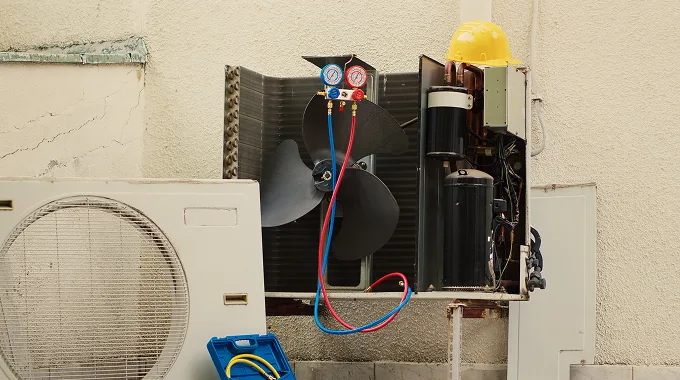
The condenser plays a crucial role in any air conditioning system, ensuring effective heat exchange and consistent cooling performance. Over time, worn-out or inefficient condensers can compromise system reliability, increase energy costs, and impact comfort levels. Our professional Condenser Replacement Services are designed to deliver long-lasting, high-performance solutions for diverse industries, including commercial, industrial, and residential applications. We provide advanced condenser units engineered for maximum energy efficiency, low operating noise, and reduced vibration, helping you maintain a comfortable and productive environment. With expert installation, reliable OEM parts, and a focus on sustainability, our services not only improve cooling efficiency but also extend equipment life while lowering maintenance costs. Whether you need a full replacement or a customized upgrade, our team ensures your system operates at peak performance with minimal downtime.

Air-cooled condensing units deliver high energy efficiency, low noise, minimal vibration, and cost-effective maintenance. Applications: Best suited for locations with strong airflow availability and reduced dependence on water resources.
Compact design with excellent heat exchange capacity, ideal for space-limited areas and high-demand cooling systems. Advanced condensing units use less energy than older models, cutting operating costs and boosting efficiency.
Advanced condensing units use less energy than older models, cutting operating costs and boosting efficiency.
Upgrading outdated condensers improves cooling reliability, ensures temperature accuracy, and extends system lifespan.
Low-noise and vibration-free operation enhances comfort and creates quieter, more efficient environments.
New-age systems help businesses cut carbon emissions while ensuring compliance with environmental regulations.

Condenser Replacements offered as part of Replacements services ensure efficient cooling system performance. By upgrading worn-out condensers, businesses achieve energy savings, improved airflow, and reduced maintenance costs while ensuring consistent operation in HVAC and refrigeration systems.

Boosting cooling efficiency, energy savings, and product display performance in commercial refrigeration setups.

Protecting temperature-sensitive cargo with retrofit and maintenance solutions tailored for large-scale facilities.

Energy-efficient retrofits ensure seamless kitchen operations, enhanced safety, and improved guest comfort.

Reliable upgrades maintain stable temperatures, clean environments, and smooth refrigeration system performance.

Custom retrofit solutions lower operating costs, optimize airflow, and enhance equipment safety in heavy-duty use.


Typical signs include persistent high condensing pressure, inadequate heat rejection, frequent overheating, corrosion, refrigerant leakage, excessive noise and declining cooling performance. A condenser should be professionally assessed before replacement because similar symptoms can also result from blocked airflow, dirty coils, fan problems, incorrect refrigerant charge or other system faults.
Repair may be appropriate when the problem involves a serviceable fan, electrical component, minor issue or cleanable coil. Replacement becomes more attractive when the heat exchanger is severely corroded, repeatedly leaking, physically damaged, inefficient or no longer suitable for the system's operating requirements. The decision should consider reliability and lifecycle cost, not just the repair price.
A correctly selected condenser can improve heat rejection and help the refrigeration or AC system operate closer to its intended design conditions. Efficiency gains depend on condenser capacity, ambient conditions, airflow, refrigerant, system design and operating load. In Saudi Arabia, selection should account carefully for high outdoor temperatures and the required cooling duty.
Common causes include corrosion, inadequate airflow, blocked or dirty coils, fan failure, excessive operating temperatures, refrigerant-related issues, poor maintenance and mechanical damage. Incorrect sizing can also create operating problems. Identifying the original failure cause before installing a replacement is important; otherwise, the new condenser may experience the same operating conditions.
Selection should consider cooling capacity, refrigerant type, condensing temperature, ambient design temperature, airflow, fan configuration, electrical requirements, physical dimensions and system compatibility. The replacement should be matched to the actual application rather than selected solely by physical size. A technical assessment can confirm whether the proposed condenser is suitable for the existing system.
An air-cooled condenser rejects heat directly to surrounding air, generally using fans. A water-cooled condenser transfers heat to a water circuit and typically requires associated water-side equipment. The appropriate configuration depends on system capacity, available infrastructure, ambient conditions, water availability, maintenance requirements and project design.
It can, particularly when the existing condenser is inefficient, damaged, undersized or unable to reject heat effectively. However, savings are not automatic. The replacement must be correctly selected and integrated with the compressor, refrigerant circuit, controls and airflow system. Energy performance should therefore be evaluated as part of the complete cooling-system assessment.
The installation period depends on condenser size, equipment accessibility, refrigerant circuit configuration, electrical work, lifting requirements and whether the facility can be taken offline. Smaller replacements can be relatively quick, while large industrial installations may require coordinated shutdowns and commissioning. A site inspection provides a more reliable project schedule.
There is no single standard price because condenser capacity, configuration, brand, refrigerant, installation requirements and site conditions can vary significantly. Additional costs may include refrigerant recovery, lifting, electrical work, piping modifications and commissioning. A site assessment and equipment specification are required to produce a meaningful quotation.
Yes, a condenser can often be replaced as an individual component when the compressor, controls, evaporator and other system components remain suitable. Compatibility must be verified before installation, including capacity, refrigerant, operating pressures and electrical requirements. If other components are also obsolete or inefficient, a broader retrofit may provide better lifecycle value.
Next-Gen Cooling. Made for Saudi
Environments.
We provide advanced commercial cooling solutions that reduce emissions and drive energy-efficient, sustainable performance.
Tell us more about yourself and what
you have got in mind.
Our Solutions
Certificates
ISO 9001

ISO 14001
ISO 45001

ICV
 UAE
UAE
 Oman
Oman
 Qatar
Qatar
 KSA
KSA
 Kuwait
 India
India

Social Media


Certificates
ISO 9001
ISO 14001
ISO 45001
ICV
UAE
KSA
Oman
Kuwait
Qatar
India


