



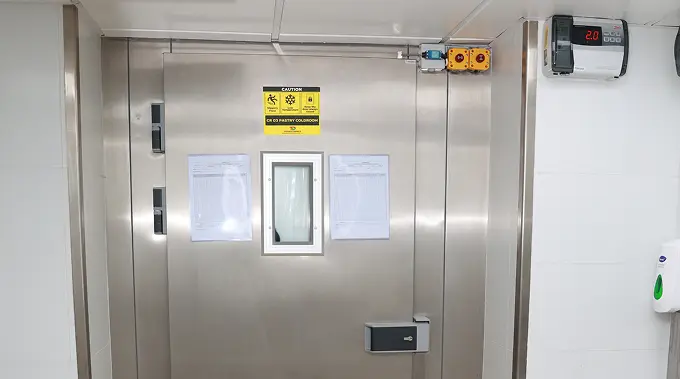
Walk-in freezers are engineered as controlled environments where refrigeration, insulation, airflow, monitoring, and construction work together to maintain the required storage conditions. The system can be specified according to temperature requirements, heat load, room dimensions, door configuration, usage patterns, and the characteristics of the products being stored. Proper coordination of these elements helps minimise unwanted heat gain, support consistent air distribution, and maintain stable conditions during routine loading and unloading. Panel construction, floor design, refrigeration capacity, defrost requirements, and temperature controls can also be selected according to the operating environment and expected storage load. This approach allows the freezer to accommodate different site layouts and operational requirements while supporting dependable long-term performance.

Walk-in freezers use insulated panel systems designed to limit heat transfer and maintain stable sub-zero storage conditions. PUR, PIR or Quadcore options can be selected according to the required temperature, room design and operating environment.
Rigid, CFC-free polyurethane insulation helps minimise heat transfer through the freezer envelope. Panel selection should consider target temperature, ambient conditions and the thermal requirements of the stored products.
PVC-coated panel surfaces provide a durable, easy-to-maintain finish for temperature-controlled storage areas. The selected cladding can support hygiene, moisture resistance and long-term performance in demanding food-storage environments.
Insulated wall, ceiling and floor systems can be configured for the expected operating and loading conditions. Panel thickness, floor insulation and surface finish should be selected according to room temperature, traffic and application requirements.
Panels are precision-cut and configured around site dimensions, door positions, storage layout and refrigeration requirements. Custom construction helps maximise usable space while supporting effective airflow and temperature control.

A walk-in freezer is more than an insulated room; it supports the day-to-day movement and protection of frozen inventory. From receiving and staging to storage and retrieval, the space can be planned around stock volumes, handling routines, product categories, and operational access across retail, foodservice, processing, healthcare, and distribution facilities.

Supermarkets, convenience stores, and grocery chains depend on these systems to maintain exceptional product freshness while creating visually appealing displays that draw customers in.

Logistics providers benefit from dependable cold storage and transit solutions that ensure precise temperature control, safeguarding product quality at every stage of the supply chain.

Compact yet powerful systems, custom-designed for back-of-house operations and commercial kitchens, provide hotels, restaurants, and catering services with reliable performance and optimal efficiency.

Specialized storage solutions designed to maintain precise temperatures for medical supplies, vaccines, laboratory equipment, biological samples, and clinical reagents.

Advanced solutions for post-harvest storage, milk chilling, and on-farm cooling, ensuring product freshness and quality are preserved from the source all the way to the shelf.


A commercial walk-in freezer is typically designed to maintain temperatures around -18°C or below for frozen-food storage, although the required setpoint depends on the product, storage period and applicable food-safety requirements. The system should be selected and commissioned according to the actual product specification rather than using one temperature for every application.
Start with the quantity and type of products to be stored, required storage duration, loading frequency and available installation space. Then consider shelving or racking, aisle requirements, door openings, product loading temperature and expected future capacity. These factors determine the freezer volume and refrigeration capacity required for reliable temperature control.
High-performance insulated panels with low thermal conductivity are generally preferred for freezer applications. The insulation thickness should be selected according to the required temperature, ambient conditions and energy-performance objectives. Properly sealed panel joints, doors and floor insulation are equally important because thermal bridges and air leakage can increase the refrigeration load.
Electricity consumption varies considerably according to freezer size, insulation, refrigeration capacity, ambient temperature, product load, door openings, setpoint and operating hours. A larger freezer does not automatically consume energy at a fixed rate. Accurate estimation requires calculating the freezer's heat load and refrigeration duty under actual operating conditions.
Energy efficiency can be improved through effective insulation, well-sealed doors, correctly sized refrigeration equipment, efficient compressors and condensers, suitable controls and regular maintenance. Limiting unnecessary door openings and keeping condenser airflow unobstructed also helps. Equipment should be selected for the site's ambient conditions rather than relying solely on standard laboratory ratings.
Cost depends on freezer dimensions, panel thickness, insulation specification, flooring, doors, refrigeration capacity, temperature requirement, electrical configuration, accessories and installation conditions. Site location, access and commissioning requirements can also affect project cost. A detailed load calculation and site assessment are needed for an accurate quotation.
Installation time depends on freezer dimensions, panel configuration, refrigeration equipment, site readiness, electrical connections and required accessories. A straightforward installation can be completed relatively quickly, while larger cold-storage projects may require additional preparation, refrigeration installation and commissioning. A project schedule should be established after reviewing the site and equipment specification.
Required refrigeration capacity depends on the freezer's internal volume, insulation, ambient temperature, product load, product entry temperature, door-opening frequency, lighting, people and equipment inside the room, and desired pull-down time. A proper heat-load calculation should be completed before selecting the refrigeration system to avoid undersizing or unnecessary oversizing.
Use well-insulated doors with effective gaskets, minimise unnecessary openings and organise loading to reduce the time the door remains open. Air curtains or other suitable measures may also be considered depending on the application. The refrigeration system must have sufficient capacity to recover temperature after loading and frequent door activity.
Walk-in freezers are widely suited to supermarkets, restaurants, hotels, catering businesses, food processors, wholesalers, distribution centres and other operations requiring bulk frozen-food storage. They are particularly useful where businesses need larger organised storage capacity than upright or reach-in freezers can provide and where maintaining a controlled cold chain is essential.
Next-Gen Cooling. Made for Saudi
Environments.
We provide advanced commercial cooling solutions that reduce emissions and drive energy-efficient, sustainable performance.
Tell us more about yourself and what
you have got in mind.
Our Solutions
Certificates

ISO 9001

ISO 14001

ISO 45001

ICV
 UAE
UAE
 Oman
Oman
 Qatar
Qatar
 KSA
KSA
 Kuwait
 India
India

Social Media


Certificates
ISO 9001
ISO 14001
ISO 45001
ICV
UAE
KSA
Oman
Kuwait
Qatar
India


